In this article, the author discusses the European Commission study on the future of the EU fishing fleet, which highlights the challenge of balancing ecological sustainability, decarbonisation, and economic viability. The article explores whether fleet modernisation – including safer vessels, improved working conditions, and new low-carbon technologies – should automatically be considered an increase in fishing capacity, and discusses the implications of this debate for fisheries management both within the EU and in African waters where EU distant-water fleets operate.
Reading time: 7 minutes
According to the authors of the European Commission study European Union’s fishing fleet: evolution, challenges and future, the EU fleet face a triple challenge.
It must remain within ecological limits and contribute to EU biodiversity conservation objectives. It must undergo an energy transition requiring new technologies and lower carbon emissions. And it must remain economically and socially viable, offering safe and attractive working conditions for a new generation of fishers.
Addressing these three challenges simultaneously is not an easy task. Rebuilding fish stocks and restoring marine ecosystems are essential if fleets are to remain economically viable in the long term. At the same time, the transition to lower carbon fishing may require new propulsion systems, alternative fuels, larger fuel storage volumes, batteries or other onboard technologies.
Improving the attractiveness of the sector for younger generations also requires safer vessels, better working conditions and more comfortable accommodation. These adaptations could require changes to vessel design and, in some cases, additional onboard space. The question therefore becomes whether all increases in vessel size should automatically be considered increases in fishing capacity.
1. Increasing capacity – for what purpose?
This has brought renewed attention to the way the EU defines and regulates fishing capacity. For decades, the Common Fisheries Policy (CFP) has managed fleet capacity through two simple indicators: gross tonnage (GT), which measures vessel volume, and kilowatts (kW), which measure engine power. These indicators were designed to prevent the return of the overcapacity that contributed to the overexploitation of many European fish stocks.
But the challenge facing policymakers today is very different from that of the 1990s and early 2000s. The question is no longer only how to prevent vessels from becoming more efficient at catching fish, but also how to allow fleets to become safer, cleaner and more attractive places to work without undermining the objective of sustainable fisheries.
There is therefore a need to determine whether existing capacity indicators adequately distinguish between capacity that contributes to fishing pressure and capacity that serves environmental, safety or social objectives.
Alternative fuels (such as hydrogen) often require larger fuel tanks or storage systems. New propulsion technologies may require additional machinery space. Improved accommodation standards require larger living quarters, while better safety standards may require different vessel layouts. Yet all of this additional space is currently counted within the same capacity framework as the space used for fishing operations.
“Fishing capacity is determined less by GT or engine power than by the combination of technological innovations and operational practices. The key challenge, therefore, is to distinguish between capacity increases that enhance fishing performance and those intended to support decarbonisation efforts and improve crew working conditions.””
The study therefore questions whether GT and kW remain adequate indicators of fishing capacity. This has also led the authors to explore concepts such as ‘safety tonnage’ and ‘decarbonisation tonnage’. The objective is not to increase fishing pressure, but to distinguish between vessel volume devoted to harvesting fish and vessel volume devoted to safety, energy transition or crew well-being. Modern fishing vessels derive much of their effectiveness not only from their size or engine power but also from technological improvements, fish-finding electronics, gear design, propulsion efficiency, fish hold configuration and operational practices. As a result, harvesting capacity can increase even when registered GT and kW remain unchanged.
One particularly interesting aspect concerns the difference between the engine power installed on board and the actual power used in fishing operations. Two vessels with identical registered kW may have very different harvesting capacities because of differences in propulsion systems, towing efficiency, gear configuration or onboard technology. The study does not formally propose regulating propeller power or towing power, but it points to an approach of fishing capacity in which actual harvesting capability matters more than nominal vessel characteristics.
The study argues that management systems must be capable of distinguishing between improvements that enhance safety, energy efficiency or profitability and those that effectively increase fishing pressure on resources.
However, a major practical challenge remains: enforcement. Even the current system, based on GT and kW, has faced difficulties in ensuring that registered capacity accurately reflects actual fishing pressure. More sophisticated indicators linked to harvesting capability, technological efficiency or operational power may be more accurate, but they would also require stronger monitoring, reporting and verification systems.
The issue is therefore not only about finding better indicators to measure fishing capacity, but also about ensuring that fisheries authorities have the means and the will to measure and enforce them effectively.
2. What does it mean for EU Distant Water Fleets operations in African waters?
The study was not designed to examine the external dimension of the CFP. Its only case study on distant-water fisheries focuses on a specific Portuguese pelagic longline fleet, making it difficult to draw conclusions about the diversity of EU fleets operating in third-country waters.
Nevertheless, if Europe is reconsidering how it measures fishing capacity, it must also consider how this new approach will apply to fleets fishing beyond EU waters.
The study repeatedly emphasises that fishing capacity should be evaluated in relation to fishing opportunities. Within the EU, this means establishing Total Allowable Catches (TACs) and effort limits based on a scientific evaluation of the state of stocks and political considerations.
For the EU Distant-Water Fleet (DFW) fishing in African waters, however, fishing opportunities are determined through various access arrangements negotiated with coastal countries. Whether fishing under a Sustainable Fisheries Partnership Agreement (SFPA) or under private access arrangements, EU DWFs are expected to respect fishing opportunities limits established by third countries and to do so in a manner consistent with sustainable fisheries management.
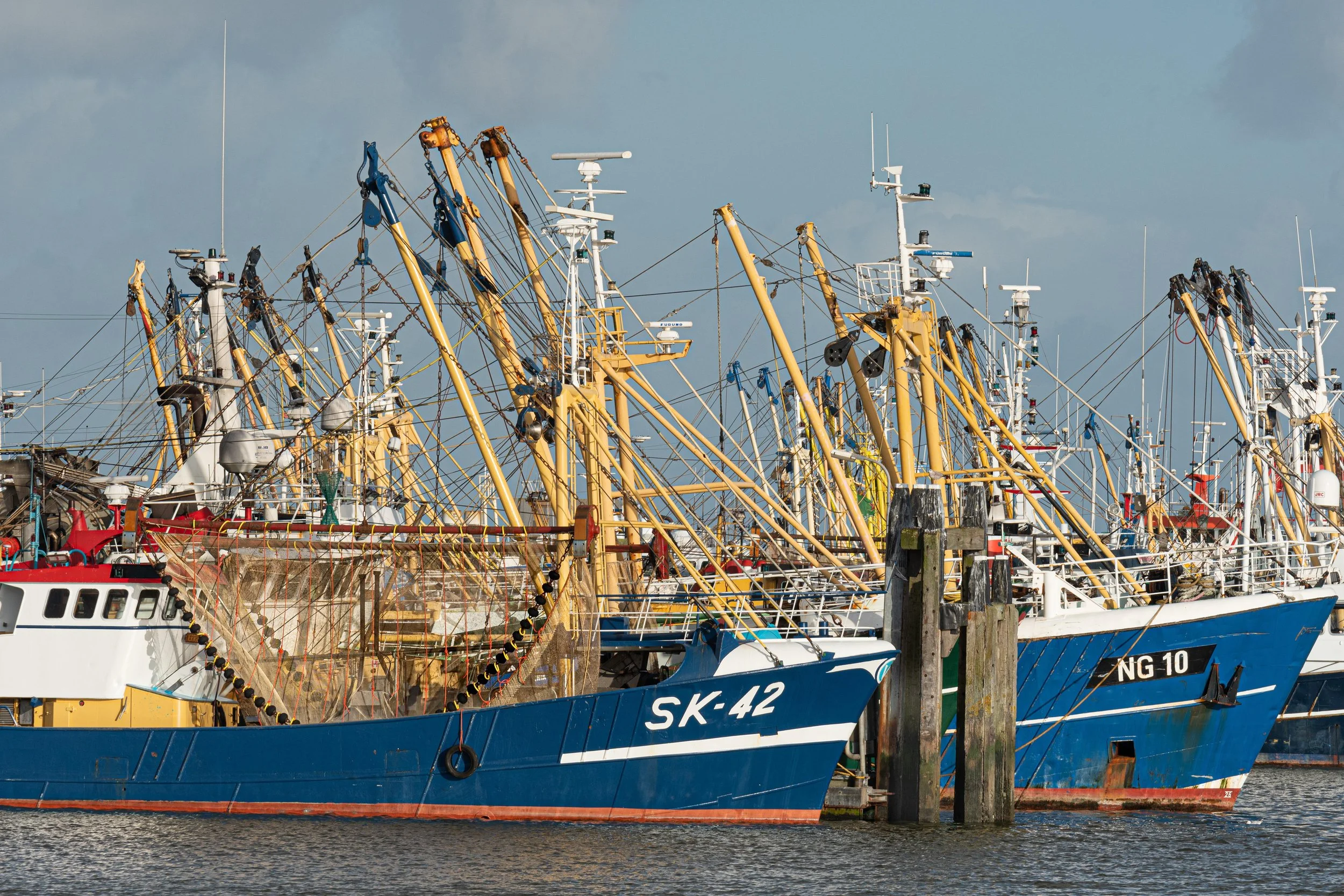
Technological efficiency gains in the EU’s distant-water fishing fleet call into question the relevance of traditional indicators of fishing capacity and highlight the need to reassess how fishing opportunities are negotiated and evaluated under SFPAs to ensure their long-term sustainability. Photo: Dutch fishing vessels, by Sabine van Erp.
If the EU concludes that GT and kW no longer adequately reflect harvesting capacity, this discussion cannot remain confined to European waters, as EU vessels operating in African waters are subject to the same technological developments identified by the study. This raises an important question for African partner countries: if vessels become more efficient at locating, catching, processing or storing fish without any change in their registered capacity, how can third countries managers ensure that the fishing opportunities granted continue to correspond to the level of fishing pressure that was originally envisaged?
This has potential implications for future SFPA evaluations. If harvesting efficiency can increase significantly without changes in registered GT or kW – this phenomenon is known as “technological creep” –, questions arise as to whether fishing opportunities negotiated under SFPAs fully capture changes in the effective fishing pressure of EU DWF. Future SFPA evaluations may need to pay more attention to technological change and increased efficiency when assessing how sustainable are the fishing opportunities granted under SFPAs.
The study’s findings also reinforce ongoing calls for greater transparency. African fishers and civil society organisations have increasingly highlighted the need for transparency not only regarding fishing agreements and catches, but also regarding beneficial ownership of the vessels of foreign origin fishing in their waters.
Importantly, in 2022, as a first step in that direction, OACPS Member States have formally recognised the need to improve beneficial ownership reporting in fisheries, providing an important political foundation for future reforms aimed at strengthening accountability and fair access to marine resources.
However, if registered GT and kW provide only a partial picture of fishing capacity, such reporting should go beyond beneficial ownership structures to include better information on vessel characteristics, technological capacities and fishing practices.
Food security considerations make the study even more relevant for Africa. Many of the fish resources targeted by EU DWFs contribute directly or indirectly to local food systems, local communities employment and income.
If the EU improves its approach for measuring more accurately fishing capacity, it should help answer the question African stakeholders increasingly ask: food security for who, and under what conditions?
The study also highlights that, if modernisation and energy transition are to be encouraged, mechanisms will be needed to demonstrate that this does not translate into increased pressure on the resources, of partner countries in the case of DWF.
“Transparency must be ensured at every level, from identifying the beneficial owners of vessels to understanding the true capacity of fleets and their practices at sea. It is an essential prerequisite for accountability, equity, and the sustainable management of fishery resources.””
If the future EU fleet policy seeks to favour lower-carbon and lower-impact fishing methods, this could be achieved by applying environmental and social criteria when allocating fishing opportunities to DWF, as called for under article 17 of the current CFP.
Such an approach could help strengthen the coherence between the EU’s internal fisheries objectives and its external commitments on sustainable development. In that context, it’s interesting to note that the study recommendations point towards greater flexibility in reallocating fishing opportunities and linking public support to sustainable practices.
This discussion echoes the long-standing call from African small-scale fishers for access agreements to be assessed not only against economic aspects but also on their contribution to sustainability, local development and food security.
3. Modernising without catching more: the challenge facing the European fleet in Africa
As the European Commission prepares a future strategy for the external dimension of fisheries, the debate initiated by this study should therefore not remain an internal European discussion. For African coastal states and fishing communities, the key question is simple: how can EU fleet modernisation, energy transition and improved profitability be achieved without increasing pressure on the resources and livelihoods upon which millions of people depend?
Banner photo by Paul Einerhand.

This article examines the deadlock in negotiations between Mauritania and the EU over a new fisheries agreement, focused on European fleet access and the EU’s financial contribution. As the Commission prepares its Vision 2040 for fisheries and aquaculture, it argues that negotiations should also address sustainable fisheries management and benefits for Mauritania’s small-scale fishing communities.