

According to popular belief, a 45th wedding anniversary – the blue sapphire anniversary – celebrates a profound commitment to the partnership and shared history.
Looking into the future of such relationship involves focusing on shared goals, accepting changes, and deepening connection – not just extending the past.
For 45 years, the European Union (UE) has signed fishing access agreements with coastal states across Africa, the Pacific, and beyond. A recent study published in Nature Sustainability takes a long look back at these agreements, tracing their evolution from the late 1970s to today.
The researchers document how a small number of European fleets have consistently captured the lion’s share of fishing opportunities and economic benefits from these agreements. They link this concentration of benefits to lasting power asymmetries between the EU and many African and Pacific coastal states, shaped by broader structural factors such as economic dependency and uneven negotiating capacities.
“Transparency in fisheries agreements is essential to ensure fair management and distribution of marine resources. “”
The study provides valuable historical insights, confirming what African coastal fishing communities have long experienced: access agreements are not neutral technical tools; they are political instruments that structure who has access to marine resources, who profits from them, and who bears the economic, social and environmental costs.
One of the study’s strongest contributions lies in its historical scope. By compiling a rare long-term dataset, the authors make for example visible how EU external fisheries agreements have steadily narrowed their focus on some fisheries, particularly tuna fisheries. However, this perspective also leaves important areas to be explored.
Joint ventures and private access: a parallel reality
One important area that falls outside the scope of the study is the expansion of joint ventures and private access arrangements in parallel with – and sometimes at the expense of – EU access agreements. In regions like West Africa, these arrangements can exceed the scale of official EU access agreements.
Recent information concerning opaque joint ventures involving vessels of EU origin, in countries such as Guinea-Bissau or Liberia, illustrate how, in the absence of adequate transparency and oversight, such arrangements may undermine governance and complicate assessments of who controls fisheries resources.
Encouragingly, steps are now being taken at EU level – notably by the Long Distance Fisheries Advisory Council, an advisory body to the European Commission involving stakeholders – such as EU fleets, unions and NGOs, to address both transparency and sustainability issues linked to joint ventures. They are working to identify best practices, in order to ensure all EU vessels under joint ventures operate transparently and sustainably, do not compete with artisanal fishers, and contribute to long term social and economic benefits for the coastal countries.
These discussions reflect a growing recognition of the need for greater policy coherence beyond formal access agreements, ensuring that EU-linked vessels operating under alternative arrangements do not undermine national development objectives and local fisheries. Based on existing information, the implications of joint ventures for sustainable development could have been further discussed in the study.
Beyond the dataset: voices from small-scale fishers
Perhaps the most striking limitation of the study is the near absence of African and Pacific coastal state perspectives, particularly those of fishing dependent communities, as the study rather focusses on EU fleets, subsidies, and legal frameworks.
From their perspective, access agreements are not abstract policy instruments. They directly influence daily realities: availability of fish, safety at sea, income stability, food security, and the viability of coastal livelihoods.
Fishers have long documented that, in contexts where regulation, enforcement, and protection of coastal areas are insufficient, industrial fleets of foreign origin – whether operating under agreements, joint ventures, chartering or other arrangements – can intensify competition at sea, encroach on inshore zones, damage artisanal gear, and put pressure on already strained fish stocks. For small-scale fishers, this often translates into declining catches and growing uncertainty about livelihoods that have sustained communities for generations. These pressures are felt most acutely by women fish processors, whose work depends on a steady and affordable supply of fish. Importantly, these dynamics reflect the cumulative impact of multiple fleets, including fleets of foreign origin, inadequate spatial planning, and limited state capacity to enforce rules.

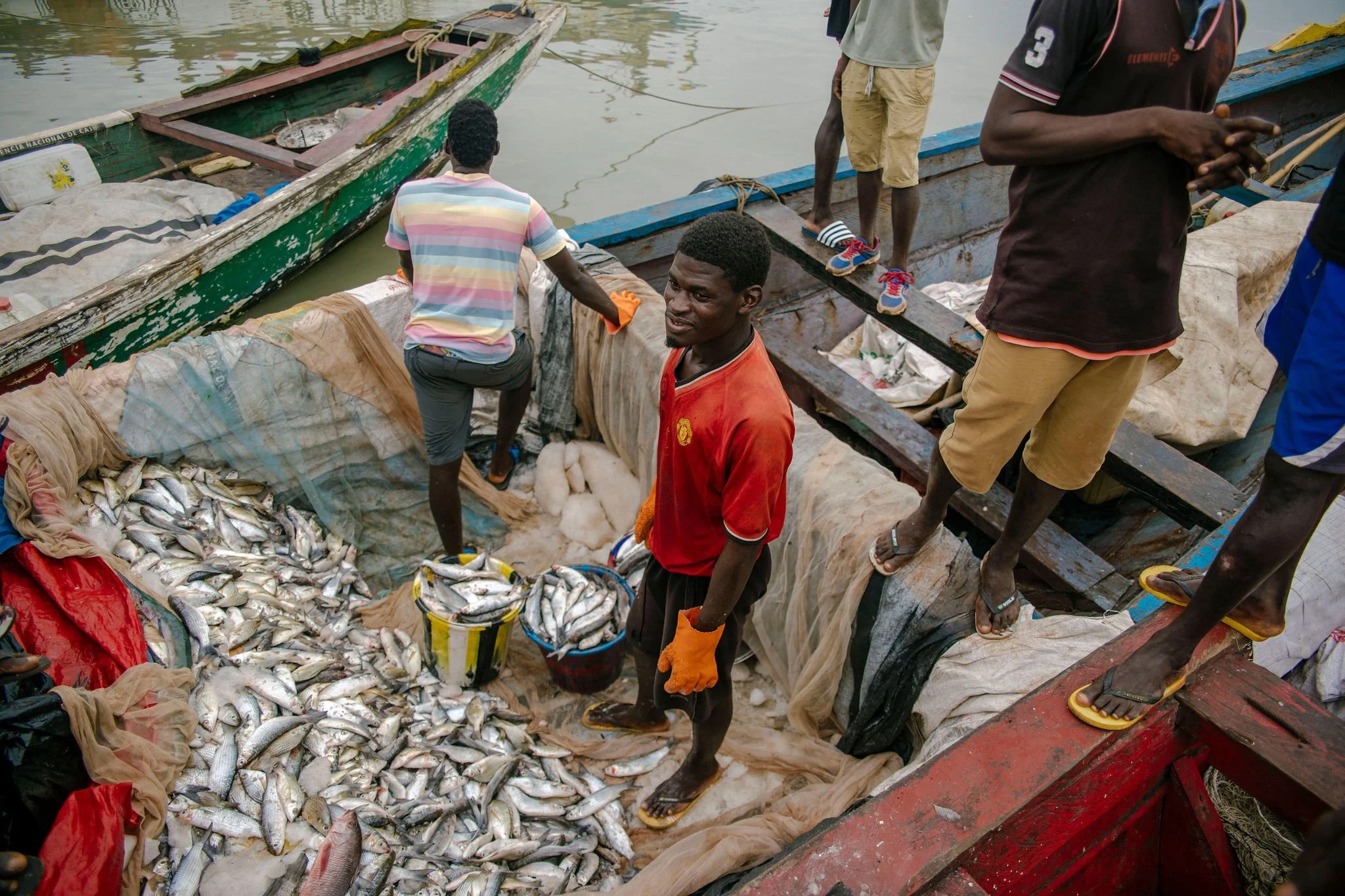
Small-scale fishers in Africa and the Pacific face declining catches and livelihood uncertainty. Exclusion from negotiations from EU fishing access agreements amplify these pressures, affecting communities and women fish processors. Photo: a man and a woman carrying a basket of fish at Gunjur landing site, by Aliou Diallo.
For decades, small scale fishers have advocated for fairer EU access agreements, and some of their demands have been reflected in agreements provisions, including not allowing EU vessels into artisanal fishing zones or granting no access for EU fleets to species caught by artisanal fishers, like the octopus in Mauritania . In parallel, EU access agreements have increasingly included funding for fisheries management, research and monitoring, etc., under what is known as “sectoral support”. The persistent problem, however, lies less in the text of the agreements themselves than in their uneven application. Limited enforcement capacity – including for clauses on transparency, non-discrimination, and top-down governance – allow some strict technical conditions to be by-passed (like embarkment of observers on super trawlers), or sectoral support funds to be used for some inefficient projects, and often leave artisanal fishers excluded from the negotiations and implementation of the agreements.
The limits of an EU-centric approach
Another shortcoming of the study is that, implicitly, it still treats the EU, through its access agreements, as the dominant external fishing actor shaping outcomes in African coastal states. While the historical role of EU access agreements is undeniable, this framing obscures the growing impact of other distant-water fleets, notably from Asia.
In several regions, fishing pressure from these fleets now rivals or exceeds that of EU vessels operating under access agreements. Their activities are often characterised by lower transparency and limited public data.
“Through access agreements, small-scale fisheries communities must be recognized as rights holders and full partners in defining the future of their fisheries.””
The study rightly notes that future research on non-EU access arrangements is essential, while acknowledging that the opacity surrounding these other access arrangements remains a major obstacle.
This observation reinforces, rather than diminishes, the relevance of EU action: as one of the few actors operating through formal, treaty-based frameworks, the EU is relatively well placed, among distant-water fishing actors, to set benchmarks for transparency and accountability that others may eventually be pressured to follow.
Conclusion: from access agreements to partnerships
The study highlights the need for the EU to engage, in the future, in truly cooperative arrangements, with ‘a strong emphasis on fair benefit-sharing, local onshore development, and prioritization of the well-being of artisanal fishers and coastal communities’. As the study itself put it, ‘this might imply more financial cost for the EU and its fleets and a change of paradigm, letting go of historical privilege and economic power’.
For coastal countries fishing communities, it would mean being recognised not as passive stakeholders, but as rightsholders and partners in shaping the future of their fisheries.
After 45 years, such a shift would not mark the end of the relationship, but rather its long overdue maturation. As the EU is currently reviewing its fisheries agreements and its fisheries external action, it would be appropriate to review them in a way they become true and equal partnerships, to the benefit of African coastal communities.
Banner photo: Gunjur landing site, The Gambia, by Aliou Diallo.

This article examines the deadlock in negotiations between Mauritania and the EU over a new fisheries agreement, focused on European fleet access and the EU’s financial contribution. As the Commission prepares its Vision 2040 for fisheries and aquaculture, it argues that negotiations should also address sustainable fisheries management and benefits for Mauritania’s small-scale fishing communities.