This article examines the deadlock in negotiations between Mauritania and the European Union over a new fisheries agreement, which appear to relate primarily to access for European fleets to Mauritanian waters and the EU’s financial contribution. As the Commission prepares its Vision 2040 for fisheries and aquaculture, the author argues that the parties should also address should also address what a future partnership would change in practice for the sustainable management of fisheries and the benefits it would deliver to Mauritania, particularly its small-scale fishing communities.
Reading time: 8 minutes
On 29 September, the European Commissioner for Fisheries, Costas Kadis, confirmed that the European Union and Mauritania had not yet managed to conclude a new fisheries agreement protocol.
This deadlock comes as the European Commission is preparing its ‘Vision 2040’ for fisheries and aquaculture, which is intended to define, among other things, a ‘new generation’ of Sustainable Fisheries Partnership Agreements. The issue therefore goes beyond simply resuming negotiations on access for European fleets and the EU’s financial contribution. It also raises the question of what a potential future partnership would actually change in terms of the sustainability of fisheries resources and the benefits Mauritania can expect, particularly to its fishing communities.
1. A disagreement beyond tonnes and euros
The current protocol, signed in 2021, expires on 14 November 2026. Costas Kadis stated that he wished to have a direct exchange with his Mauritanian counterpart, and that the future agreement ‘should take into account the observations of the European auditors’. This last point is important, and is not new: as early as 2015, the European Court of Auditors highlighted the under-utilisation of the fishing opportunities negotiated under the EU–Mauritania agreement and the relatively high cost of the protocol then in force.
The current disagreements appear to concern both financial terms and access for European vessels. The shipowners’ association Anamar states that Mauritania is seeking a higher financial contribution. The Mauritanian ministry responsible for Fisheries, meanwhile, referred to ‘a reorganisation of access linked to the risks facing several overexploited pelagic species’. A note from Latvia provides further details on the disagreement. In June, it stated that the European Commission had reportedly proposed, for the negotiations, fishing opportunities for small pelagic species of 93,000 tonnes per year, compared with 225,000 tonnes under the current protocol. Latvia considers this volume insufficient to meet the needs of the European fleet concerned.
However, data examined by the EU-Mauritania Joint Commission in January 2026 puts the actual scale of this reduction into perspective: the reported catches by European pelagic trawlers amounted to around 94,000 tonnes in 2024 and 2025. These figures are therefore very close to the 93,000-tonne level reportedly proposed for the new agreement and significantly below the fishing opportunities negotiated under the current protocol. When compared with recent actual catches, rather than with the ceiling negotiated in 2021, the proposed reduction in fishing opportunities is consequently much less pronounced.
Under the current operation of Sustainable Fisheries Partnership Agreements (SFPAs), a reduction in fishing opportunities would result in a corresponding reduction in the financial contribution associated with access. This may explain part of the disagreement over the financial terms of the future protocol. Sectoral support, which is separate from the payment for access under the current protocol, should not be automatically affected by a reduction in fishing opportunities.
Beyond questions of tonnage and financial contributions, the future partnership will need to address the expectations of Mauritania and its coastal communities. It will also be important to assess its potential implications for the resources on which Mauritanian fishers depend, marine habitats, and the ability of fishing communities to influence decisions, particularly concerning the use of sectoral support.
In recent discussions with CFFA, Mauritanian small-scale fishers described the benefits of the agreement and its successive protocols for coastal communities as limited. They also noted that their organisations had neither been informed about nor involved in the ongoing negotiations or in the planning and use of sectoral support under the latest protocol.
2. By-catches: a disguised form of access to resources?
The immediate concern raised by Mauritanian small-scale fishers relates to octopus: they all call for its exploitation to remain reserved for Mauritanian operators, particularly small-scale fishers. The current protocol does not permit targeted fishing for octopus. The species, which has been a driving force behind the development of the local small-scale fisheries sector, nevertheless remains overexploited. European shrimp trawlers are permitted to retain up to 8% of their catch as cephalopod by-catch. In 2022, these vessels landed 87 tonnes of cephalopods as by-catch, with octopus accounting for the largest share.
The absence of provisions allowing targeted octopus fishing is therefore not, in itself, sufficient to guarantee that European vessels do not have access to the species. A potentially significant quantity of this high-value resource may still be retained as by-catch and subsequently marketed by European shrimp trawlers. The challenge is therefore to assess the total fishing mortality affecting the octopus stock, including mortality resulting from by-catch, and to determine how this affects the status of the resource and the prospects for developing the local fishery.
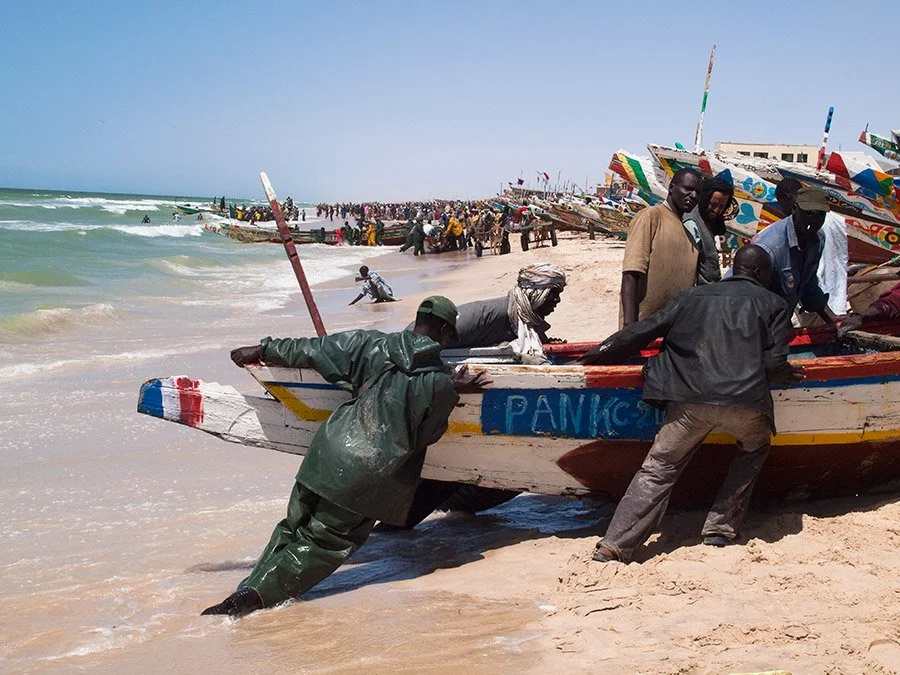
Local small-scale fishing communities are primarily concerned with octopus, access to which is restricted to Mauritanian operators. Nevertheless, European fleets landed 87 tonnes of cephalopods as by-catch in 2022. These species are of high commercial value and can therefore be sold. Photo: The beach at Nouadhibou, by Evgeni Zotov.
A similar issue arises in the fishery targeting small pelagic species. In 2023, pelagic trawlers accounted for approximately 34% of Mauritania’s black hake production as by-catch, while the stock is overexploited. In both cases – octopus and hake – a fishery officially targeting another stock is exerting significant fishing pressure on an overexploited species.
The meeting of the EU–Mauritania Joint Commission held on 26–28 January 2026 recognised the need to collect additional data on target species catches and by-catch and highlighted the difficulties encountered in recruiting and retaining observers on board. Any future protocol should therefore quantify fishing mortality by species across all fishing categories, regardless of whether a species is targeted or caught as by-catch. Measures relating to selectivity, zoning and biological closures should help to reduce by-catch, while adequate scientific observer coverage on board should be ensured.
3. Protecting sensitive habitats: a test of credibility
In its report on the June 2025 meeting, the Joint Scientific Committee recommended the long-term protection from trawling of five areas of biological interest located along a series of cold-water coral reefs. The committee proposed designating these areas as marine protected areas. Together, they account for only 0.72 per cent of Mauritania’s Exclusive Economic Zone (EEZ). According to the available monitoring data, European vessels targeting hake and shrimp are the only bottom trawlers known to operate in these areas.
In a parliamentary question tabled in September 2026, MEP Isabella Lövin asked why this issue had not been addressed during the negotiations. If such a specific and limited recommendation cannot be implemented through a protocol, this would significantly undermine the credibility of the stated objective of making SFPAs more sustainability-oriented. Any future arrangement should therefore provide for the effective protection of these areas from bottom trawling.
4. Participation means having a say in decisions
The small-scale fisheries sector must be able to influence the planning of sectoral support, monitor its implementation and assess its results. The future partnership should therefore establish an effective and permanent mechanism for information-sharing and participation, guaranteeing representative organisations advance access to relevant documents, the opportunity to put forward their own priorities, and a reasoned response from the parties to the agreement to their proposals.
The latest EU-Mauritania Joint Committee, held in January 2026, reports on a workshop organised with beneficiaries of sectoral support and announces the publication of its report. This greater transparency is a positive step, but a single workshop is not sufficient to ensure meaningful participation. It would be important to know which organisations were involved, and to what extent their proposals changed the resulting decisions.
Such participation should not be limited to matters relating to sectoral support. It should also extend to the fundamental choices underpinning the partnership: which resources may be made available to European vessels and under what conditions.
The future SFPA must translate these principles into concrete provisions when assessing the surplus, setting fishing opportunities and, for small pelagic species, establishing landing and market-supply obligations, with a view to strengthening their contribution to food security.
5. Funding governance in line with the country’s needs
The current European contribution under the SFPA amounts to 60.8 million euros per year, of which only 3.3 million on average is allocated to sectoral support. A reduction in fishing opportunities should not result in a reduction in sectoral support: Mauritania’s needs in terms of fisheries governance remain substantial, irrespective of the volume of European catches.
A credible framework for future agreements must not only, as is currently the case, distinguish between financial compensation for fishing opportunities and sectoral support for fisheries governance. It must also tailor sectoral support to Mauritania’s needs in areas such as research and fisheries control covering all fleets, protection of the five areas of biological interest, infrastructure and services for fishing communities, and transparency in the issuing of fishing licences. Consideration should therefore be given to accompanying a reduction in European access to Mauritania’s resources with increased support for the sustainable management of those resources and for the communities that depend on them.
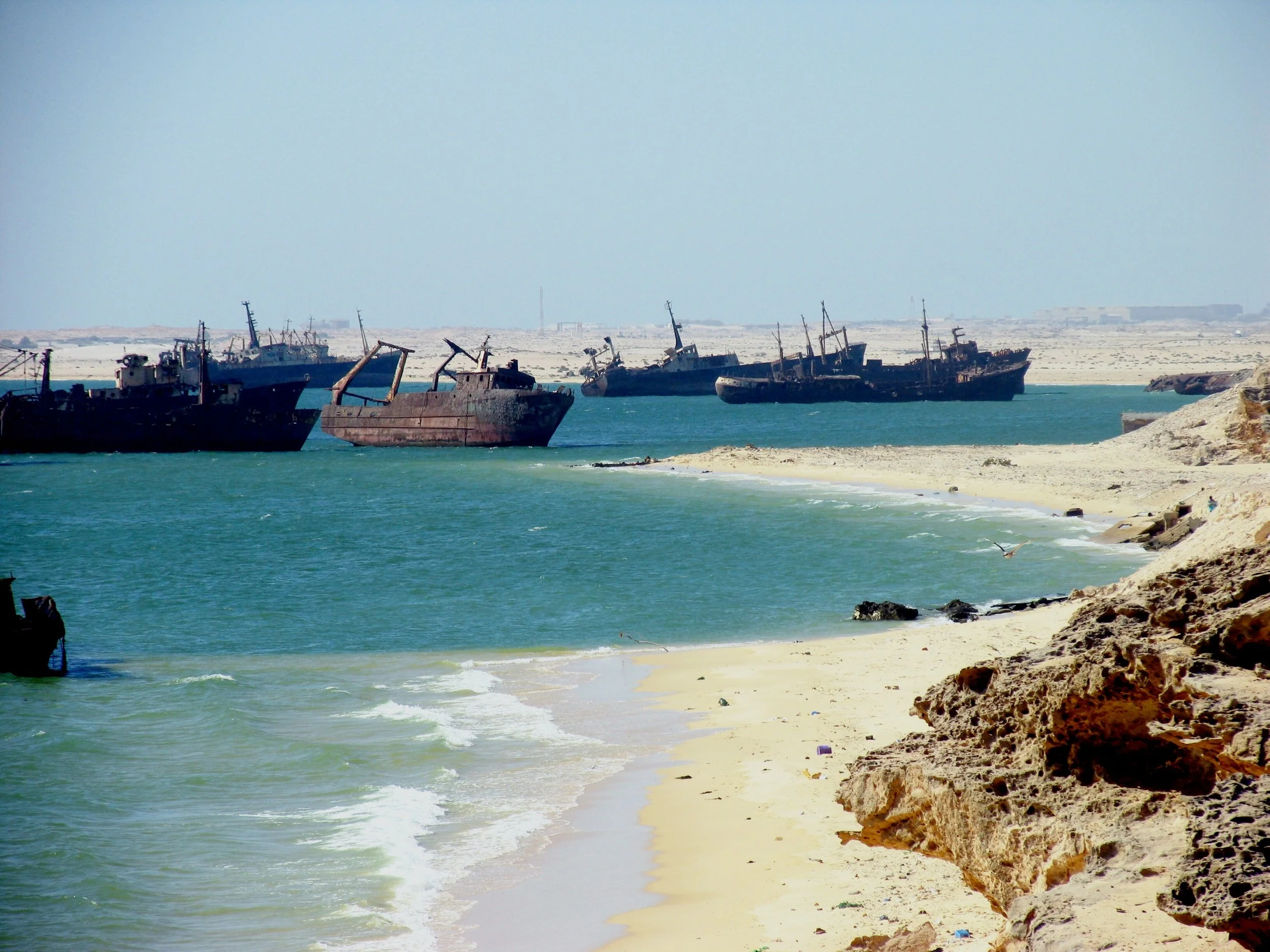
The prospective evaluation of the 2021–2025 EU–Mauritania Agreement recommends its renewal, while proposing several structural adjustments. In particular, it highlights the need to shift sectoral support towards budget support, in line with European rules on public finance and transparency. Photo: Shipwrecks in Nouadhibou, by Sebastian Losada.

Sectoral support should eventually evolve into budgetary support for the fisheries sector, following an examination of the legal and financial conditions, as suggested by the prospective evaluation of the 2021–2025 SFPA. European rules require, in particular, a credible sectoral policy and guarantees concerning public finances and budgetary transparency. Simply renaming the current payments would therefore not be sufficient.
This suggestion echoes the Commission’s internal audit, published in 2025, which calls for clarification of the legal nature of the assistance and, where appropriate, for sectoral support to be aligned with the provisions governing budget support, alongside improved coordination between DG MARE and DG INTPA.
Better coordination with other European cooperation instruments could help mobilise additional funding. However, this also carries a risk of diluting fisheries priorities within a broader ‘blue economy’ approach, or of replacing concrete commitments with vague promises that are difficult to verify. Whatever instrument is chosen, the responsibilities, amounts, beneficiaries and results must remain publicly available and measurable.
6. Different scenarios, common requirements
The two parties may still conclude a new protocol before the November 2026 deadline, temporarily suspend access, or agree on a transitional arrangement. The European fishing sector has, for example, proposed a one-year extension to ensure continuity of fishing activities.
Whatever scenario is ultimately chosen, the same substantive questions will need to be addressed: what level of fishing opportunities is compatible with the actual state of the stocks and the cumulative fishing effort exerted by all fleets? How can by-catches of octopus and hake be reduced? When will the five coral reef areas be closed to trawling? How will Mauritanian organisations be involved in decision-making? What specific results will be expected from sectoral support?
A transitional arrangement would therefore only be useful if it provided an opportunity to address these questions, according to a public timetable and with the participation of Mauritanian fishing organisations.
Conclusion: Will Mauritania be the first full-scale test of the new generation of SFPAs?
The disagreement comes at a time when the EU is redefining its external action in the field of fisheries. In the European Ocean Pact, the Commission announces an external action strategy comprising a new generation of SFPAs, better aligned with the EU’s broader partnerships and regional strategies.
At the end of September, five EU Member States – Spain, France, Latvia, Lithuania and Portugal – called for the Vision 2040 to strengthen the external dimension of the Common Fisheries Policy (CFP) and support the activities of the European distant-water fishing fleet. Their statement specifically cites Mauritania as an example of the positive role that long-term European investment can play in local economies and value chains. The current disagreement shows, however, that this perspective is not necessarily fully shared by the partner country: a future partnership will need to demonstrate in concrete terms how its benefits are distributed and how it addresses Mauritania’s priorities.
A new generation of fisheries agreements cannot be limited to modernising the terminology or to linking agreements more closely to European economic objectives, such as competitiveness and the supply of the European market. It should also change the way in which access, funding priorities and expected outcomes for the partner country are determined.
In Mauritania, this means, in particular, basing access on the best available scientific advice and on a transparent assessment of the total cumulative fishing effort exerted by foreign fleets; protecting small-scale fishing zones and vulnerable ecosystems; ensuring that fishing opportunities granted to certain fleets do not, through by-catch, result in the harvesting of other sensitive resources; and ensuring transparency in the operations of vessels and operators, as well as in the identification of their beneficial owners.
The partnership must also deliver tangible results for food security, employment and women in fishing communities. Sectoral support should be defined, monitored and evaluated with the involvement of Mauritanian small-scale fisheries organisations.
Whether the outcome is a new protocol, a transitional extension or another arrangement, these requirements are the conditions under which the European Union and Mauritania can turn their relationship from an access agreement into a genuine partnership, in line with the EU’s stated ambitions for 2040.
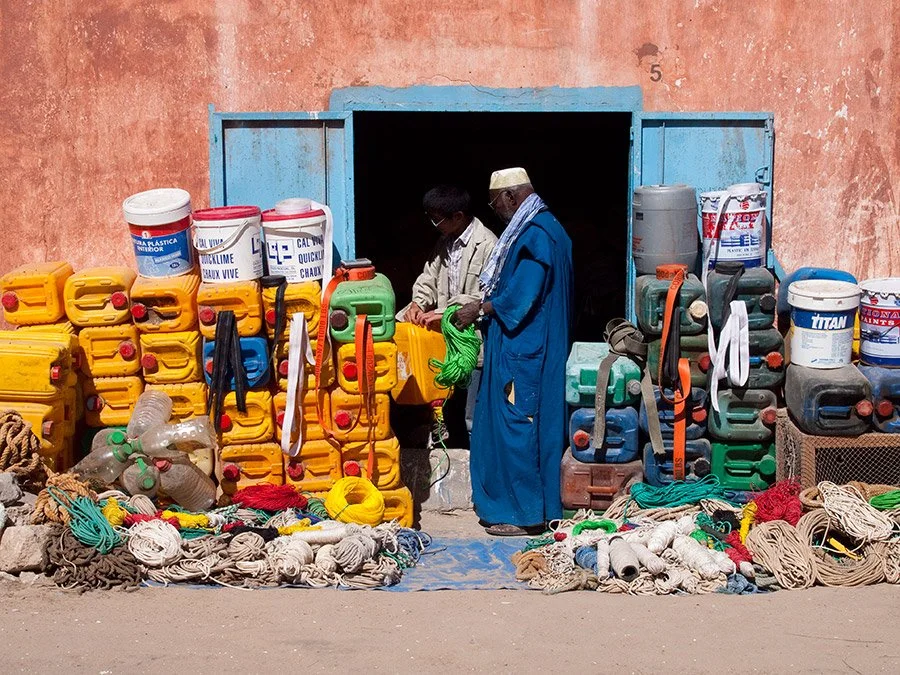
Banner photo: The market in Port-Étienne, Dakhlet Nouadhibou, by Evgeni Zotov.



This article examines the deadlock in negotiations between Mauritania and the EU over a new fisheries agreement, focused on European fleet access and the EU’s financial contribution. As the Commission prepares its Vision 2040 for fisheries and aquaculture, it argues that negotiations should also address sustainable fisheries management and benefits for Mauritania’s small-scale fishing communities.