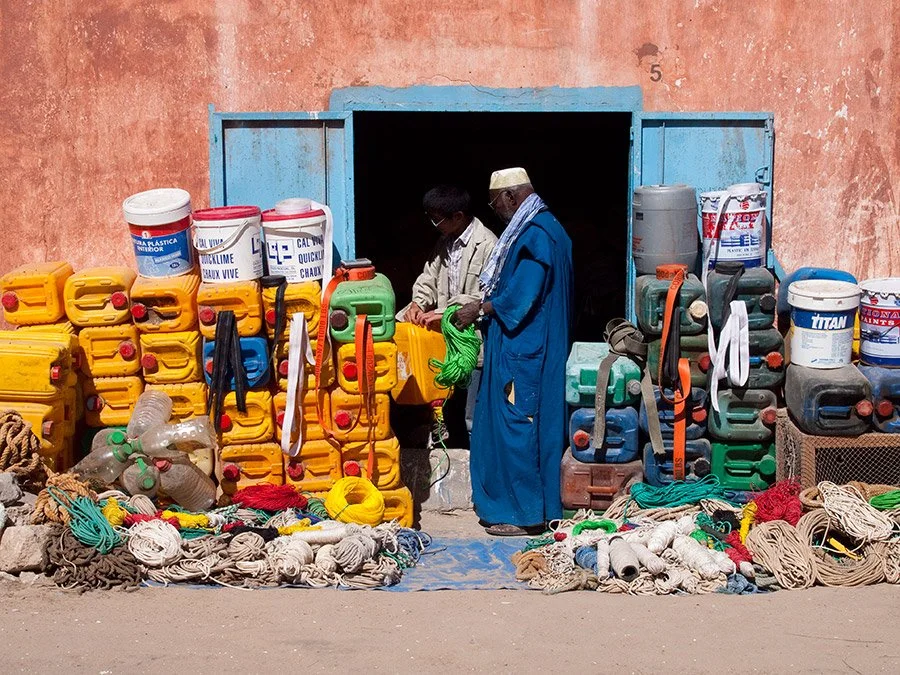
Fish is becoming increasingly scarce on African tables, even though African waters continue to supply international markets. As the EU is about to reveal its future strategy for external fisheries action, the next generation of SFPAs offers an opportunity to address this challenge. Their contribution to food security should ultimately be judged by a simple test: do they help more sustainably caught fish reach local consumers in good condition and at an affordable price?
EU fisheries funding: ‘Doing no significant harm’ is not enough
The Commission is preparing a set of guidelines for an harmonised approach to ensure EU funded activities do not undermine EU environmental objectives. For fisheries, this should not result in weaker environmental safeguards. The EU should also be supporting those fishers that have maintained low-impact and selective practices for years.
The EU is debating its Fisheries Policy – Africa should pay attention
To subsidise or not to subsidise, that is not the question
SFPA monies must reach the shore: What Mauritian artisanal fishers expect from the future fisheries agreement with the EU
Although the EU-Mauritius SFPA generates measurable macroeconomic gains, these benefits remain largely invisible to small-scale fishers. The authors highlight weak transparency, limited coastal development impact, governance issues, and inequitable access to resources, calling for a more inclusive, community-centred fisheries partnership model.
EU-Mauritania SFPA: a tool to achieve sustainability?
The Sustainable Fisheries Partnership Agreement (SFPA) between the EU and Mauritania is an opportunity to implement the “new generation” of agreements announced by the Commission, which should focus on the equitable sharing of benefits, local development, and the well-being of coastal communities that depend on fishing.
WTO Agreement on Fisheries Subsidies: Progress with many open questions
Francisco Mari, advocacy officer for global food security, agricultural trade and maritime policy at Bread for the World, reviews the WTO agreement on fisheries subsidies; following its recent entry into force. For this, he points at what till remains unaddressed and the costs and opportunities for developing countries, including the impact on small-scale fisheries.
Strengthening Inshore Exclusive Zones with small-scale fishers: A path to food security and biodiversity
Small-scale fishing communities depend on the coast and inshore waters for their livelihoods. Many African countries now recognise small-scale fisheries’ role in achieving climate and biodiversity goals. The EU should support this by strengthening priority access and funding co-management in coastal waters.
Behind a deadly shipwreck in Mauritania, some dubious European interests
Dormant but not dead: Why The Gambia - EU fisheries agreement still matters
Dormant SFPAs should not simply be considered as a pause. Since the framework agreements are still in place, they should be utilised for dialogue on science and sustainable fisheries between the two parties. Dormant agreements can also play a role in the broader regional network of SFPAs as they can help monitor and coordinate research across borders. Finally, these agreements can also continue fostering coherence between EU funding instruments.
Putting fishing communities first: Priorities for negotiating a fair EU-Seychelles Fisheries Agreement
Towards a fair and sustainable EU strategy for fisheries external action
In this position paper, CFFA contributes to the Commission open consultation on an EU strategy for fisheries external action. In it, CFFA calls for a strategy that looks into policy coherence for development, including a focus on food security, the importance of participation of stakeholders and of including human rights safeguards. In the second part of the position, CFFA looks at the coherence in the resources put forward to fund this external strategy, as essential for effective action.
The crisis is deepening for Liberia artisanal fishers: the EU must listen and act
Encouraging the reform and enlargement of the Inshore Exclusive Zone (IEZ) in Liberia would reinforce the EU leadership on responsible fisheries governance and build on recent regional trends, such as the IEZ expansion in Ghana and the Senegalese government commitment to enlarge the area reserved to artisanal fishers.
Mind your vessels: Flag states and their obligations to regulate the activities of their fishing vessels
Taking the example of the Mauritius law and looking at the general principles in international law, Pieter van Welzen looks specifically at the obligations of coastal states and their obligations to regulate their own vessels who fish in the waters of another state or in the high seas. The author also looks at cooperation between states in the monitoring of foreign vessels and finally, at how the EU can support developing coastal states in fulfilling their obligations.
Small-scale fishers should be at the centre of the European Oceans Pact
The EU should guarantee rights-based and equitable decision-making processes about ocean uses, ensuring the protection of the most vulnerable facing more powerful blue economy industries. Taking into account the role of artisanal fisheries in food security and poverty eradication in developing countries, the EU should also support SSF and sustainable fisheries management in its ocean partnership with African countries.
EU-Mauritania SFPA – Joint Committee ahead: small pelagic fish goes under the spotlight
The Joint Committee of the EU-Mauritania SFPA will meet in Nouakchott from 4 to 6 December 2024. In this article, the author makes a number of recommendations in the light of the conclusions of the Fishery Committee for the Eastern Central Atlantic (CECAF). In its latest report, CECAF described the catastrophic situation of shared stocks of small pelagics and recommended a substantial and immediate reduction in fishing effort of 60% for flat and round sardinella.
EU-Guinea-Bissau SFPA: progress for the artisanal sector, but European-owned vessels slip through the net
Although the protocol does not allow European fleets to fish for small pelagics because they are overexploited, at least 4 European vessels have reportedly reflagged to Guinea-Bissau and are fishing for these species in the region, jeopardising the region's food security and competing with small-scale fisheries.
A CFP external dimension fit for the future: more focus on good governance, less on paying access rights for EU fleets
The author makes 4 recommendations to make the external dimension of the CFP more effective: (1) the EU should shift from access agreements to fisheries governance agreements, while (2) continuing to support informed participation of stakeholders in third countries; (3) it should also ensure that all vessels of EU origin, including those reflagged, abide by sustainability standards; and (4) it should actively engage, at international level, to promote transparent, fair, and sustainable access arrangements applicable to all fleets of foreign origin fishing in developing countries.
The Gambia-EU Sustainable Fisheries Partnership Agreement negotiations: Questions arising
With Senegal’s yellow card, fisheries agreement negotiations between the EU and Senegal are at a standstill. Meanwhile, the EU will negotiate the renewal of its SFPA with The Gambia, whose waters are bordered on both sides by Senegal’s. How would access to the Gambian waters be used by EU fleets, at a time when they may be barred from Senegal waters?
Yellow card Senegal: the fight against IUU fishing must also be waged in the coastal zone
At a time when the fisheries agreement is being renegotiated, Senegal is initiating a formal dialogue with the EU on the fight against IUU fishing. As part of this dialogue, the European Union has a responsibility to improve controls on vessels of European origin, and to impose heavy penalties when they fail to comply with the rules.