
Following the publication of an EP report on the impact of Maritime Spatial Planning on fisheries, MEP Yon-Courtin spearheaded an own initiative report which was adopted by the European Parliament (EP) at its plenary session in May 2026.
In this resolution, the EP regrets that the Maritime Spatial Planning Directive (MSPD) “has not adequately delivered the expected benefits for fisheries.”
The Parliament criticises the MSPD, a directive that “tends to favour the expansion of capital-intensive and spatially exclusive economic activities”, with the risk of marginalising “traditional, mobile and collective uses of the sea,” such as small-scale fisheries. In the explanatory statement, the rapporteur Yon-Courtin echoes the outcomes of the research report: “Fishing activities face spatial restrictions, competing uses, displacement of fleets, and increased pressure on remaining grounds” and stresses that “small-scale fisheries are particularly vulnerable.”
With this resolution, the EP “emphasises the essential role of small-scale fishing”, and asks that the MSPD “takes this segment fully into account”. The resolution’s first paragraphs linger on the promises that the MSPD did not deliver for fisheries: In view of the challenges the sector faces, the MSPD neither contributed to “improving predictability and stability for fisheries activities”, nor minimised conflict between the various users of the sea.
While the implementation of the MSPD varies between different Member States, the resolution notes that they all fail to facilitate meaningful and informed stakeholder participation: “involvement often lacks early and formal engagement and consultation, offering limited opportunity for genuine influence on planning decisions.” This results in fisheries actors, particularly small-scale fishers, being “overshadowed by other, more powerful or economically important sectors,” with some sectors even bypassing consultation processes.
“Priority zones for fisheries” and co-management as a governance model
To address these shortcomings, the Parliament puts forward a series of recommendations aimed at giving fisheries a stronger place in marine spatial planning. It includes the establishment of “priority zones for fisheries” which should be “tailored to different fleet segments and sea basins, based on robust scientific and socio-economic assessments.” The resolution particularly points to the need of increasing “reserved areas dedicated to small-scale low impact inshore fishing within the 12 nautical mile zone”, recognising the sector’s vulnerability to competing maritime uses. The EP also pleads for inclusive governance where “co-management models should be promoted.”
Furthermore, during MSP process, fisheries should systematically be considered, including through “mandatory assessment of the cumulative socio-economic impacts of fishing displacement.” Compatible uses should be prioritised, the EP insists. However, when displacement does occur, there should also be “a mechanism of compensatory measures” for the fisheries sector.
“• Establish priority zones for fisheries.
• Expand reserved areas for small-scale inshore fishing.
• Promote co-management and stakeholder participation.
• Require socio-economic impact assessments of fishing displacement.
• Introduce compensatory measures when displacement occurs.
• Ensure transparent, multi-stakeholder governance.””
Regarding stakeholder participation, the Parliament asks for more “transparent, multi-stakeholder governance” in maritime spatial planning and for “feedback on how stakeholder input is used in decision-making”. The benefits of the fisheries co-management model are praised as they allow “for the direct involvement of stakeholders, better management of fishery resources, the sharing of best practices and an approach tailored to local realities.”
The resolution concludes that “the development of certain activities related to the blue economy must not be at the expense of seafood production, food sovereignty and the preservation of marine biodiversity.” And particularly in its contribution to food, the EP calls for fisheries to be recognised as a strategic sector “of major public interest.”
The Parliament therefore wants a revision of the MSP Directive to be included in the forthcoming Ocean Act, expected later this year, offering an opportunity to better safeguard fisheries interests in increasingly crowded maritime spaces.
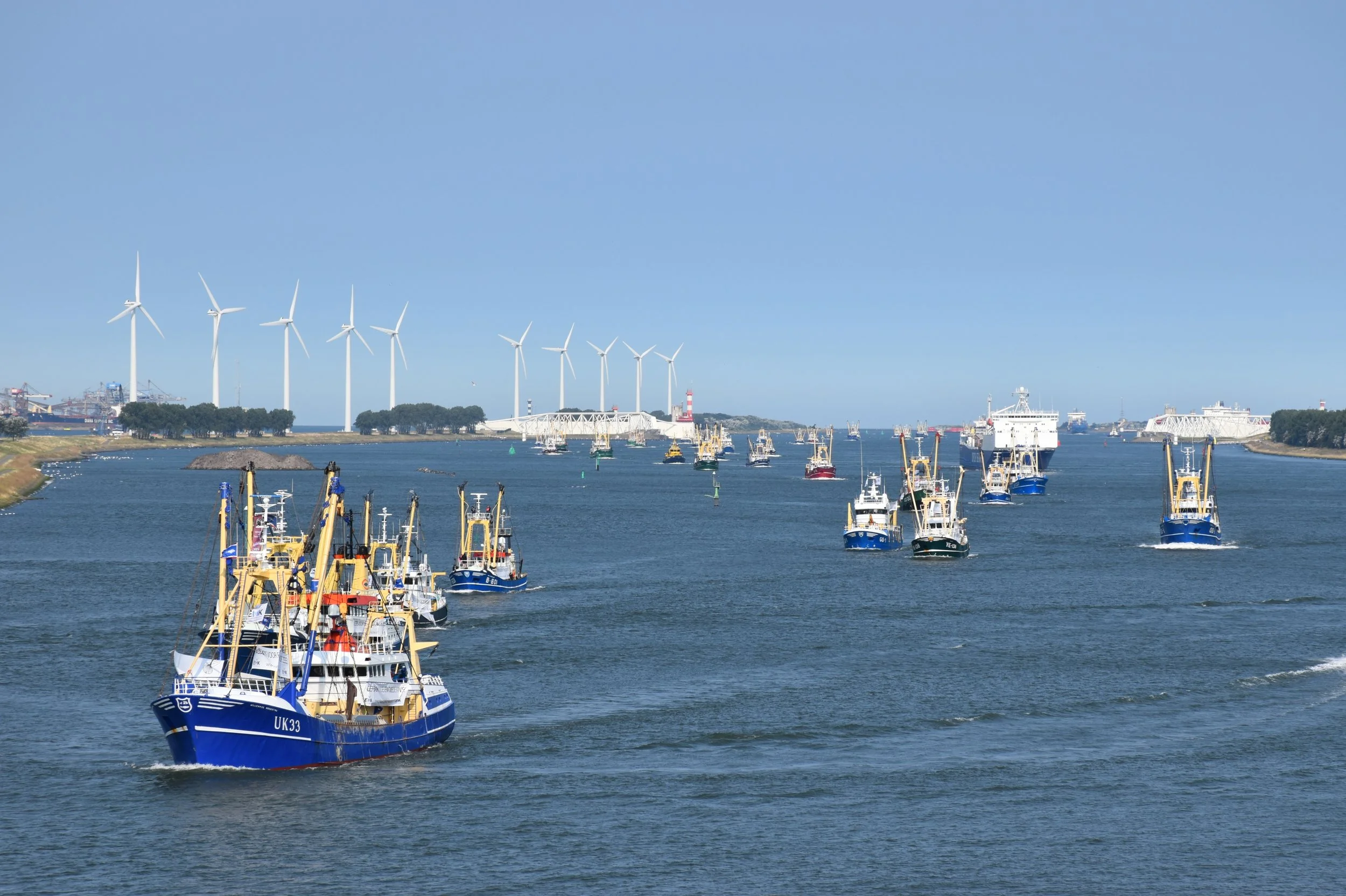
Banner photo: Nieuwe Waterweg the Netherlands. By Niels Johanes.


Ten reconnaissance licences for offshore gold mining were granted in February 2026 in Ghana’s territorial waters and are facing strong opposition from fisheries stakeholders. The company’s published map overlaps with the Inshore Exclusion Zone (IEZ), an area reserved for small-scale fisheries.